We Thought We Had Found a Terrifying Creature—Until One Tiny Detail Revealed the Truth
How a mysterious object, a moment of panic, and an unexpected discovery revealed something fascinating about the way the human brain interprets fear.
The Strange Discovery That Made Everyone Look Twice
Sometimes the most unforgettable moments begin with something so ordinary that nobody would normally give it a second thought.
A strange shape on the floor. An unfamiliar shadow behind the furniture. A small object tucked into a forgotten corner.
Under normal circumstances, these things are hardly worth noticing. But when the lighting is poor, the surroundings are unfamiliar, and someone reacts with alarm, even the smallest discovery can suddenly feel extraordinary.
That is precisely what makes the mysterious object in this photograph so fascinating.
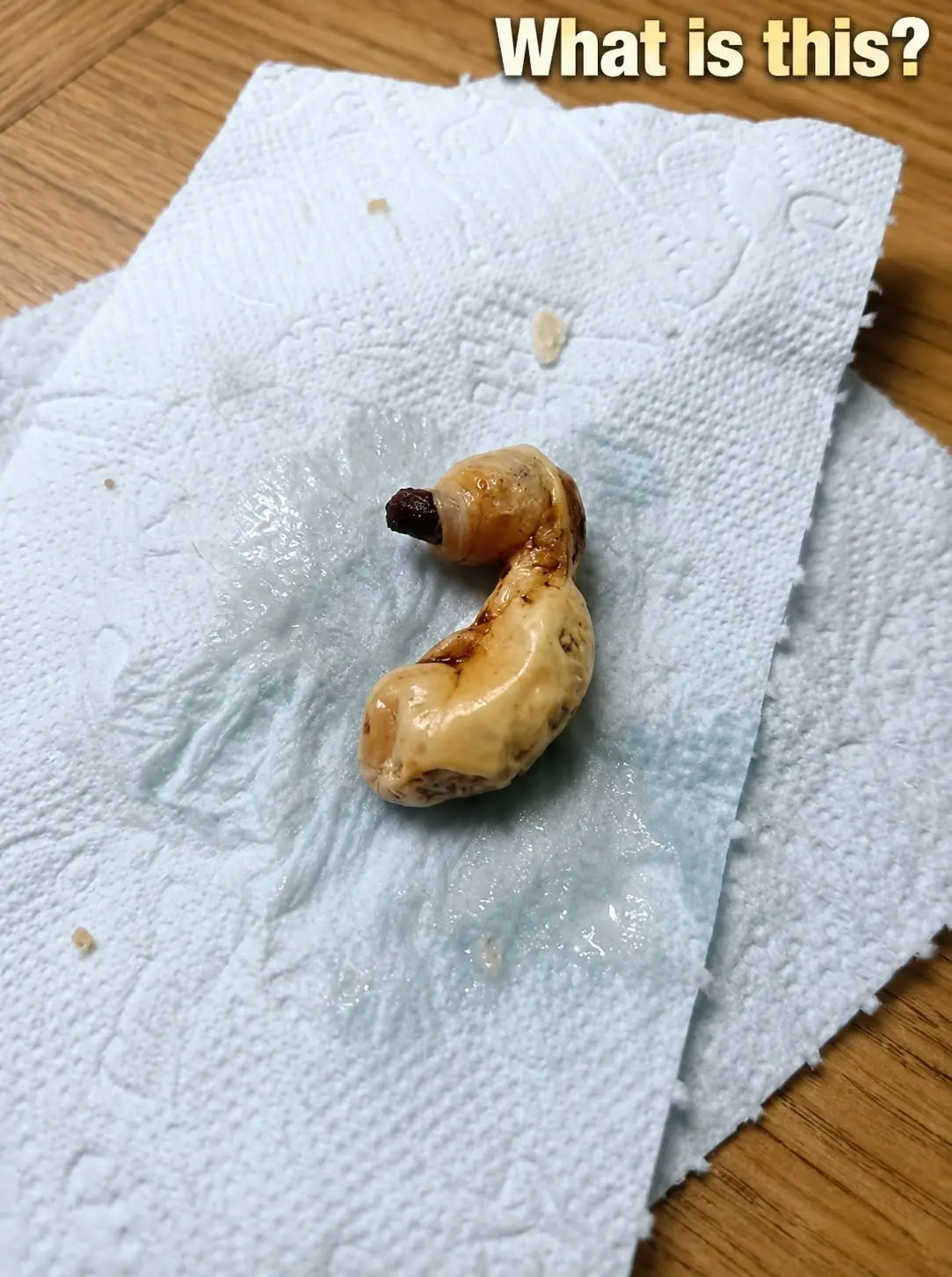
At first glance, it hardly resembles something that belongs in an ordinary household. Its curved shape, unusual texture, darkened tip, and apparent surface markings create an appearance that can be surprisingly unsettling.
Look at it quickly, without knowing anything about it, and your imagination may immediately begin offering explanations.
Could it be some kind of insect?
A tiny animal?
A strange organism?
Something that should not be inside a house?
The longer you stare, the more unusual it may seem.
And once someone suggests that the object could be alive, everything changes.
Suddenly, what originally appeared to be an unfamiliar piece of debris begins looking like a creature with a body, head, and perhaps even signs of injury.
The object itself has not changed.
Only the story surrounding it has.
That distinction is the heart of this peculiar mystery.
The original account describes a moment in which an unexpected discovery triggered alarm before a much more ordinary explanation emerged: the object may have been an old pistachio shell or another piece of food debris altered by moisture and residue.
That explanation is plausible from the photograph, although the precise identity cannot be conclusively established from the image alone.
Nevertheless, the contrast between the frightening first impression and the possibility of such an everyday explanation creates an almost perfect example of how the human mind works.
Because sometimes the scariest part of a discovery is not what we are looking at.
It is what our brains convince us we might be seeing.
The Moment Fear Takes Control
Imagine discovering something unfamiliar in a place where you expect everything to be safe and predictable.
Perhaps you are cleaning under a bed, moving old furniture, or searching behind a cabinet when you notice an object that does not immediately make sense.
You lean forward.
You look closer.
Something about its shape feels wrong.
It is not necessarily large. It is not moving. It has not made a sound.
But you cannot identify it.
That uncertainty is enough to make you uncomfortable.
Then someone nearby asks, "What is that?"
Another person moves closer, takes one look, and steps backward.
Within seconds, the atmosphere changes.
Nobody knows whether the object is dangerous, but everyone begins behaving as though danger is possible.
Ordinary curiosity transforms into caution.
A quiet room suddenly feels tense.
Even the person who originally discovered the object may begin noticing details that seemed unimportant moments earlier.
The curved section looks like a body.
The narrow end resembles a head.
Dark marks appear almost biological.
A shiny surface suggests moisture.
A small shadow creates the illusion of depth.
None of these observations necessarily proves that the object is alive.
But together, they can produce a convincing impression.
This happens because the brain does not simply record visual information like a camera.
It actively interprets what the eyes provide.
When that information is incomplete, the brain uses previous experiences, expectations, emotions, and context to fill the gaps.
Most of the time, this ability is incredibly useful.
It allows us to understand complicated environments quickly without examining every detail.
But occasionally, it also leads us toward conclusions that are dramatically different from reality.
Your Brain Is Constantly Trying to Predict What Comes Next
One of the most interesting discoveries in modern psychology is that perception is not entirely passive.
When we look at an object, information travels through our visual system, but our existing knowledge and expectations also influence how that information is interpreted.
Psychologists refer to one important part of this process as top-down processing.
In simple terms, our brains use what we already believe or expect to help us understand what we are currently seeing.
Imagine receiving a blurry photograph from a friend.
If the message says, "Look at this dangerous animal hiding in the bushes," you will probably search the image for eyes, claws, teeth, or the outline of a body.
But if the message says, "Can you find the garden decoration in this picture?" you might search for a completely different collection of shapes.
The photograph remains exactly the same.
Your expectations change the way you examine it.
Something similar can happen with mysterious household objects.
If somebody says, "It looks like a parasite," other people may begin interpreting dark spots as anatomical features.
If somebody says, "It resembles a seed," those same spots may suddenly appear to be discoloration or ordinary surface texture.
Neither interpretation should automatically be accepted as fact.
Instead, both represent possible explanations that need to be evaluated against actual evidence.
This is an important distinction because our first impression often feels more reliable than it truly is.
The brain is remarkably efficient at generating an interpretation.
It is not always equally efficient at reminding us that an interpretation is only a possibility.
That is why people can feel completely certain about something they have only glimpsed for a few seconds.
Their confidence may be genuine.
But genuine confidence is not the same as accurate identification.
Why Uncertainty Can Feel So Threatening
There is a special kind of discomfort that comes from seeing something unfamiliar without understanding what it is.
People generally prefer situations they can explain.
A familiar household object rarely demands much mental attention.
We know what a spoon looks like. We recognize a fallen leaf. We can identify a piece of paper or a discarded food wrapper almost immediately.
But an object that fits none of our familiar categories creates a problem.
Our brains want an answer.
And when the object seems potentially biological, the stakes suddenly feel higher.
Could it bite?
Could it carry germs?


0 commentaires:
Enregistrer un commentaire